
“Bravo is the backbone. Bolt it into your vehicle.”
Vehicle-mounted AI using NVIDIA IGX T5000 as its reference configuration. Its modular, upgradable architecture keeps a path open to future accelerators, including AMD. Camera coverage, vehicle-data interfaces, local models, and mission applications are selected and tested for each platform integration.
Reference Platform
NVIDIA IGX T5000
AI Performance
Up to 2,070 TOPS
Power / Input
40-130W · 12/24V DC
Storage
4 TB
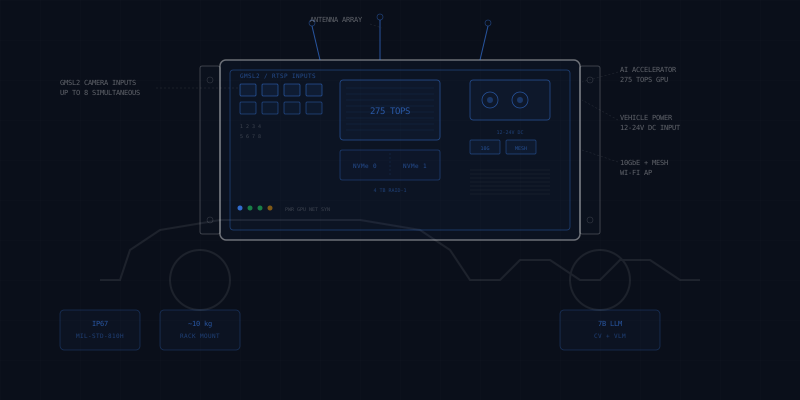
Reference Configuration Targets
Compute and module power reference: NVIDIA IGX T5000 specifications
Capabilities
Vehicle-mounted AI configured around your sensors, vehicle interfaces, mission workflow, and operator controls.
Multi-Camera CV Pipeline
Correlate candidate detections and tracks across selected camera feeds. The pilot measures camera count, coverage, accuracy, false alerts, throughput, latency, and handoff behavior.
Local Language-Model Copilot
Evaluate a 7B-class local language model for multi-turn queries and draft situation reports based on the system context your team selects. Operators review sources and approve the result.
Sensor Fusion Across Feeds
Bring selected camera, thermal, acoustic, CAN bus, GPS, and mission-system data into one operating view. We test timing, data meaning, security, and exchange behavior for each feed.
Alert Triage Agent
Ranks candidate detections by threat level, proximity, and mission context so operators can review the most important events first.
Convoy Coordination
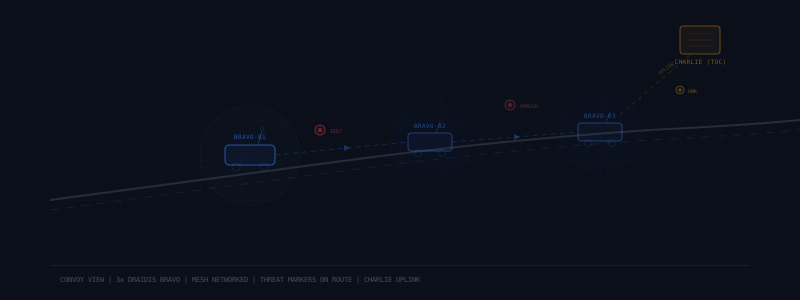
Share selected vehicle-to-vehicle data over an encrypted mesh. Models can surface possible route hazards and IED indicators for operator review. The pilot measures delivery and alert quality in your network topology.
ATAK Integration
Present vehicle overlays, possible route-risk and IED indicators, camera alerts, confidence, evidence, and recommendations in ATAK for operator review.
Deployment Scenarios
Mobile AI backbone for vehicle and base operations.
Convoy Operations
Present possible IED indicators, route-risk observations, and supporting evidence to convoy operators. Field tests measure coverage and warning performance.
Forward Command Post
Use BRAVO as a mobile command-post node to combine selected inputs from Alpha nodes, run larger local models, and support an area operating picture.
Vehicle Patrol
Local perimeter-monitoring support during patrol operations. Models prioritize candidate detections while vehicle crews retain identification and response authority.
Base Perimeter
Connect multiple cameras and selected base-defense interfaces at a fixed site, then measure coverage and alert quality under site conditions.
Operational Environment
0°
Coverage Design Target*
0
Reference Feed Target*
0B
Reference Model Size*
10GbE
Interface Design Target*
* These are pilot targets. We benchmark the delivered hardware, sensors, models, interfaces, and operating conditions during integration. You choose the operational data used to evaluate or improve a model. Operational data stays out of shared model training unless your team directs us to use it for that purpose.
Frequently Asked Questions
BRAVO is designed for vehicle integration, but the final fit is specific to the platform. We test mounting, power, cooling, electromagnetic compatibility, safety, and environmental performance on the selected vehicle. The compute starting point uses NVIDIA's published IGX T5000 specifications.
The current design target is 2-8 camera inputs through GMSL2 or RTSP, plus selected RF, acoustic, CAN bus, and mission-system interfaces. During integration, we measure camera count, frame rate, latency, coverage, and model accuracy with the sensors and operating conditions your platform will use.
BRAVO is designed around vehicle power, mirrored storage, and multiple sensor inputs. ALPHA prioritizes portability. BRAVO starts with NVIDIA IGX T5000, for which NVIDIA publishes up to 2,070 TOPS and a 40-130W module-power range. We adapt and test the shared software for each form factor.
BRAVO targets conditioned 12-24V DC vehicle input. An external-battery option can be part of the design. We test reduced-power profiles, camera count, runtime, cooling, and switchover on the delivered configuration.
No. NVIDIA IGX T5000 is the current reference configuration behind the published 2,070-TOPS and 40-130W component specifications. BRAVO uses a modular compute carrier and containerized software so future accelerator options, including AMD, can be evaluated as they become available.
Evaluate DRAIDIS BRAVO
Request a demo or download the DRAIDIS BRAVO solution brief for your team.